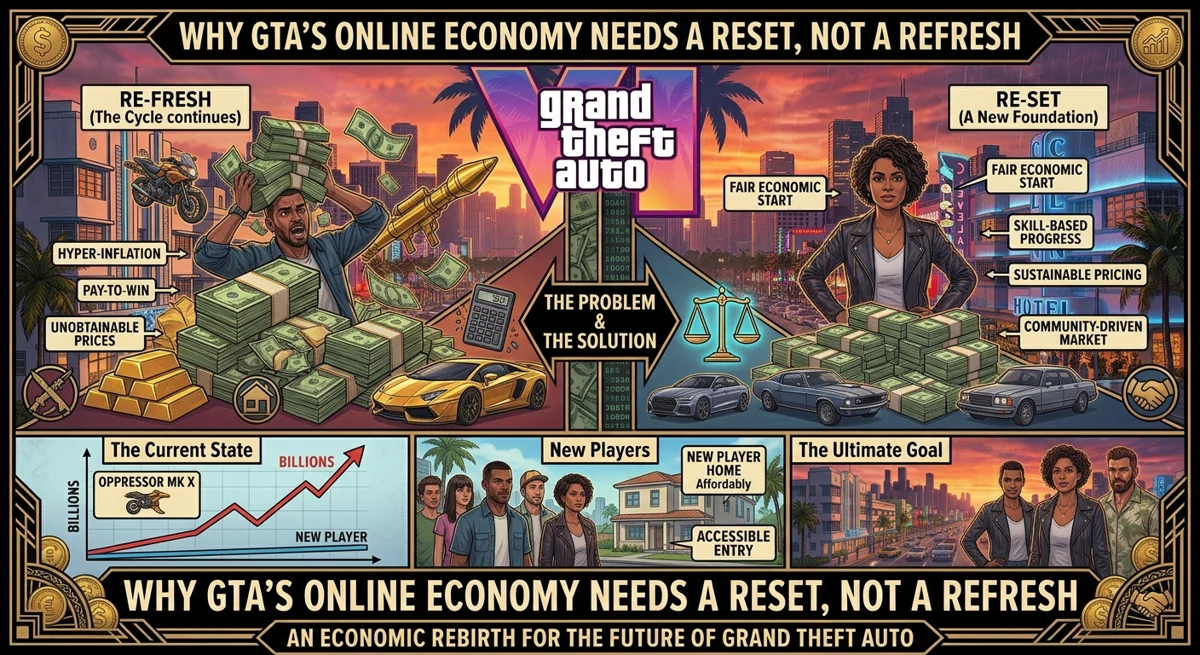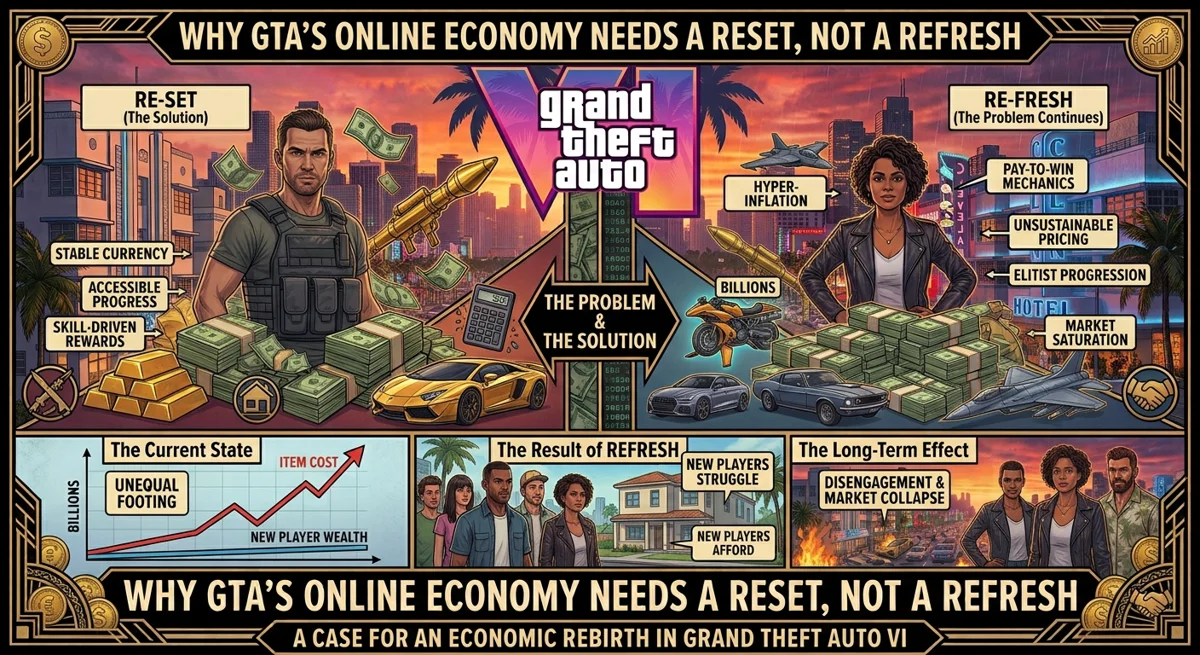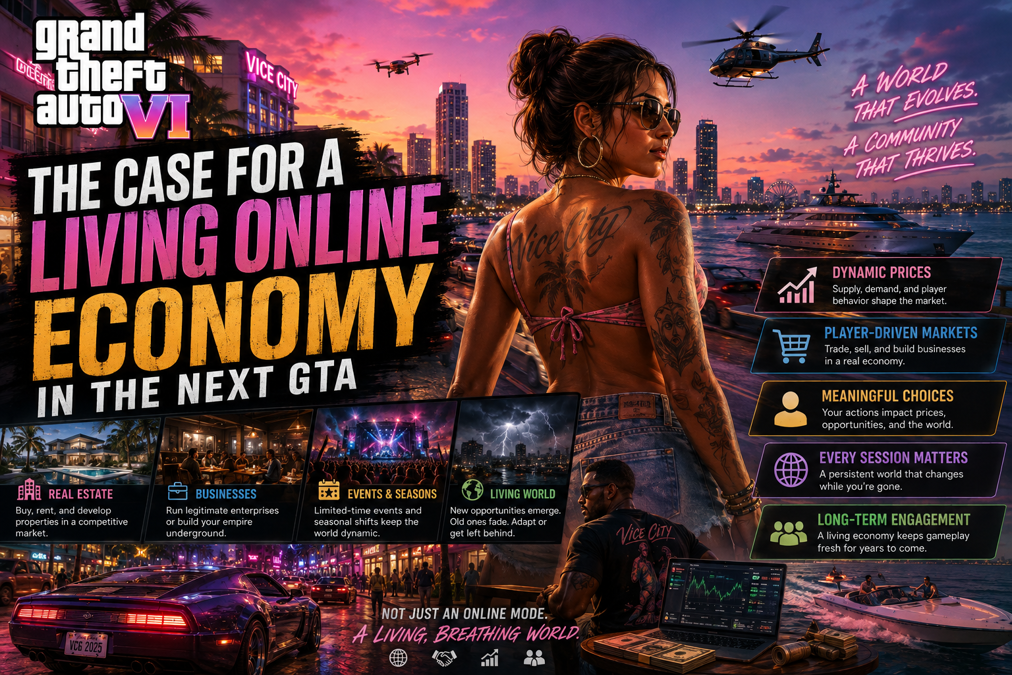
Every GTA Online player remembers a moment that broke the illusion. Maybe it was seeing a Kosatka submarine parked next to a starter apartment. Maybe it was realizing a new car cost more than a real weekend of your life — unless you swiped a Shark Card. Maybe it was the first time a hovering flying motorcycle rained explosives on your delivery van and you just… logged off. Whatever your moment was, it was the same underlying problem: an online economy that stopped feeling like a world and started feeling like a spreadsheet.
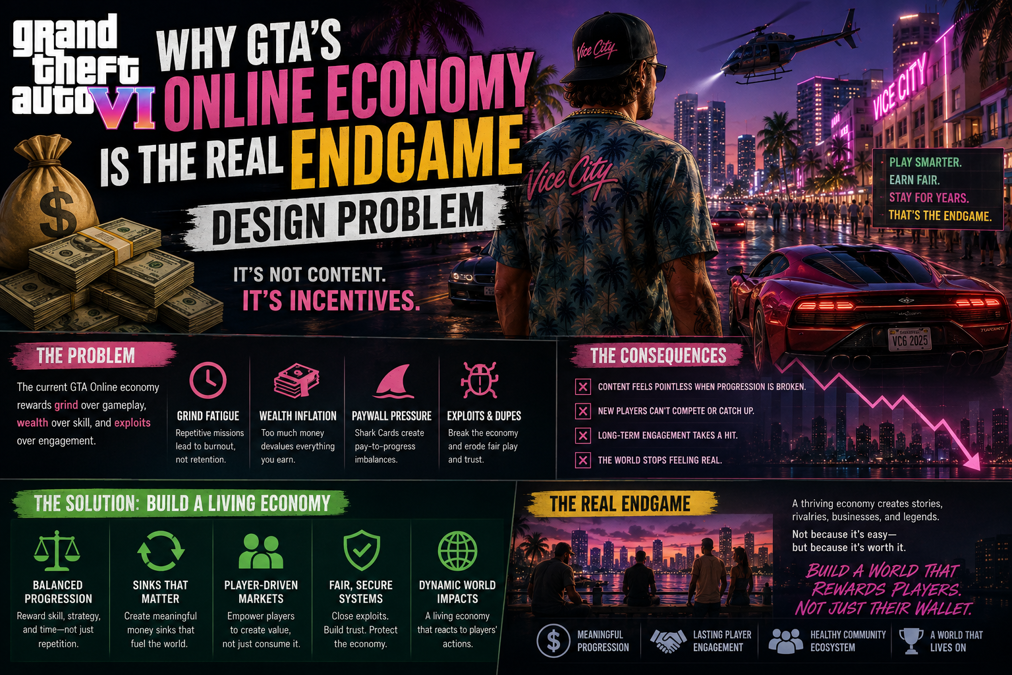
As the community turns its attention to what comes next, I want to make a case that doesn't get made often enough. Forget the map size for a second. Forget the character rumors. The single biggest design lever Rockstar has in a modern GTA is the economy — how money enters the world, how it leaves, and how that flow shapes what players actually do with their time. Get that right, and everything else — heists, businesses, PvP, roleplay — quietly falls into place.
Why the economy is the real game
In a single-player GTA, money is a pacing tool. You earn enough to buy the next weapon, the next car, the next property, and the story keeps moving. In an online GTA, money is the story. There is no ending, so the economy has to generate its own arc for each player: a reason to log in Tuesday, a goal to grind toward Saturday, a purchase that feels earned by next month.
When that loop works, the game becomes a career fantasy. You feel like a small-time hustler climbing a ladder. When it doesn't work, you feel like an unpaid intern staring at a locked door with a price tag on it. GTA Online has, at various times, been both — sometimes in the same session.
What GTA Online got right (and we shouldn't lose)
Before piling on the criticism, credit where it's due. A few things GTA Online genuinely nailed:
- Businesses as physical spaces. A nightclub, a bunker, a warehouse — these weren't menu screens. They were locations you could visit, decorate, and defend. That's a huge deal for immersion.
- Cooperative payoffs. The heist structure, at its best, gave friends a genuine reason to plan together instead of just deathmatching in a lobby.
- Long-tail content. Whatever you think of the release cadence, the game kept giving people new reasons to return years after launch. That's rare.
- Property as identity. Your apartment, your garage, your CEO office — these became a way to express who your character was without a single line of dialogue.
Any successor needs to keep these bones intact. The problem was never the framework. It was the numbers stapled onto it.
Where it broke: the escalation trap
Here's the pattern that quietly hollowed out GTA Online over the years. A new update drops. It introduces a new business or heist that pays more per hour than anything before it. To justify the new payouts, the next update introduces items priced against them — vehicles, properties, upgrades that only make sense if you're earning at the new rate. Old content becomes irrelevant. New players face a wall. Veterans feel pressure to grind the newest activity or fall behind.
This is what I'd call the escalation trap, and it's the same disease that eats most live-service economies. Every patch has to be bigger, flashier, and more lucrative than the last, because that's what generates headlines and Shark Card spikes. But the cumulative effect is a world where a first-time player and a returning veteran are playing two completely different games with the same title on the box.
The fix isn't to make everything cheaper. It's to design an economy that has actual shape — where money means different things at different stages, where old activities stay relevant, and where the ceiling doesn't keep sliding up every three months.
What a smarter online economy could look like
This is the opinion part, so take it as one editor's wishlist rather than any kind of prediction. If I were sketching design pillars for the next online mode, I'd start here:
- Separate the fantasy tracks. Not every player wants to be an arms-dealing kingpin with a flying bike. Let street-level crime, legitimate businesses, and high-end heists be parallel ladders with their own progression, not a single tower where everyone is forced upward.
- Make money sinks feel like life, not tax. Ammo, fuel, bribes, lawyers, maintenance on properties — these can drain wealth in ways that reinforce the fantasy instead of feeling like arbitrary tolls. Nobody minds paying their crew. Everybody minds paying for a menu screen.
- Protect low-level play. A new player's first ten hours should feel like a crime movie, not a tutorial for a store. That means keeping oppressive weaponized vehicles out of low-level lobbies and letting basic hustles pay meaningfully.
- Reward presence, not just grind. Passive income from businesses is fine, but the best economies reward you for being in the world doing things — driving cargo yourself, casing a target, running from cops — not for scheduling your logins around a timer.
- Design for roleplay from day one. The community has already shown, through third-party servers, that people want to live in Los Santos as much as loot it. Give official servers even a fraction of those tools — jobs, phones, businesses that other players can patronize — and the world gets exponentially more interesting.
The community is the missing balancing tool
One thing worth saying out loud: the healthiest online economies in gaming aren't the ones with the smartest developers. They're the ones with the most honest communication between developers and players. When a heist pays too much, players will find it in a day. When a car is priced absurdly, the memes write themselves within an hour.
Rockstar has historically kept the community at arm's length on economic tuning. That worked in an era where players had fewer alternatives. In 2025 and beyond, with roleplay servers, competing sandboxes, and an audience that has been burned by live-service missteps across the industry, transparency isn't a nice-to-have. It's a retention strategy. A quarterly note explaining why a payout changed would do more for goodwill than any double-money weekend.
The stakes are higher than they look
It's easy to treat economy design as a spreadsheet problem — a knob for someone in a back office to twist. But in a game where millions of people will spend hundreds of hours, the economy is the thing that decides whether those hours feel like a hobby or a second job. It decides whether the world feels alive or transactional. It decides whether new players stick around long enough to become the veterans who evangelize the game to the next wave.
The next chapter of GTA Online, whenever and however it arrives, has a rare advantage: more than a decade of lessons, from Rockstar's own hits and misses and from an entire industry's worth of live-service post-mortems. Whether those lessons actually shape the design is the question that will define this game's next ten years far more than any single feature or vehicle.
Over to you
So here's the discussion I want to have in the comments: if you could redesign one thing about how money works in GTA Online — one rule, one payout, one item — what would it be, and why? The best answers might end up in a follow-up piece.