There's a specific moment, somewhere around year three of every Grand Theft Auto Online lifecycle, when the economy stops feeling like a game and starts feeling like a spreadsheet. You log in, you see a new drip-feed vehicle priced somewhere between "a used car" and "a small house," and you do the math on how many heist replays that translates to. The fantasy of being a small-time crook clawing your way up evaporates. You are, functionally, doing a second job so you can afford pretend cars in a pretend city.
As we sit in the long quiet before the next chapter of this franchise, I want to talk about the thing I most want Rockstar to rethink — not the map, not the protagonists, not the physics engine. The economy. Because whatever shape the next online mode takes, if it inherits the math of the last one, it inherits the rot too.
The Inflation Problem Nobody Wants to Name
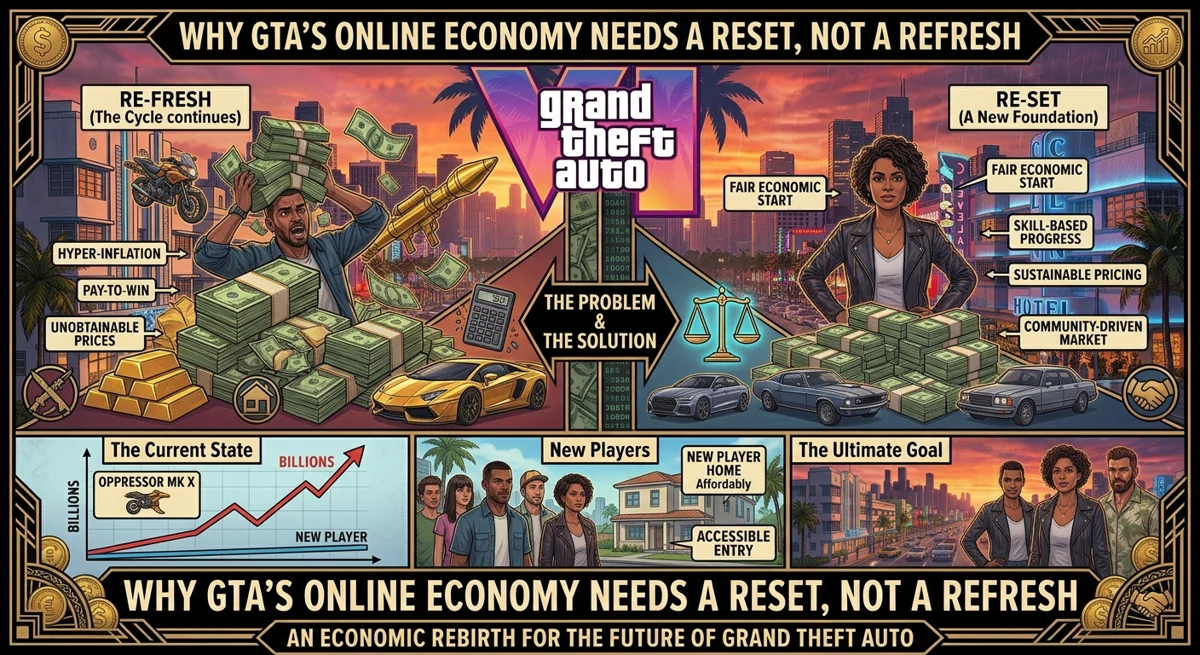
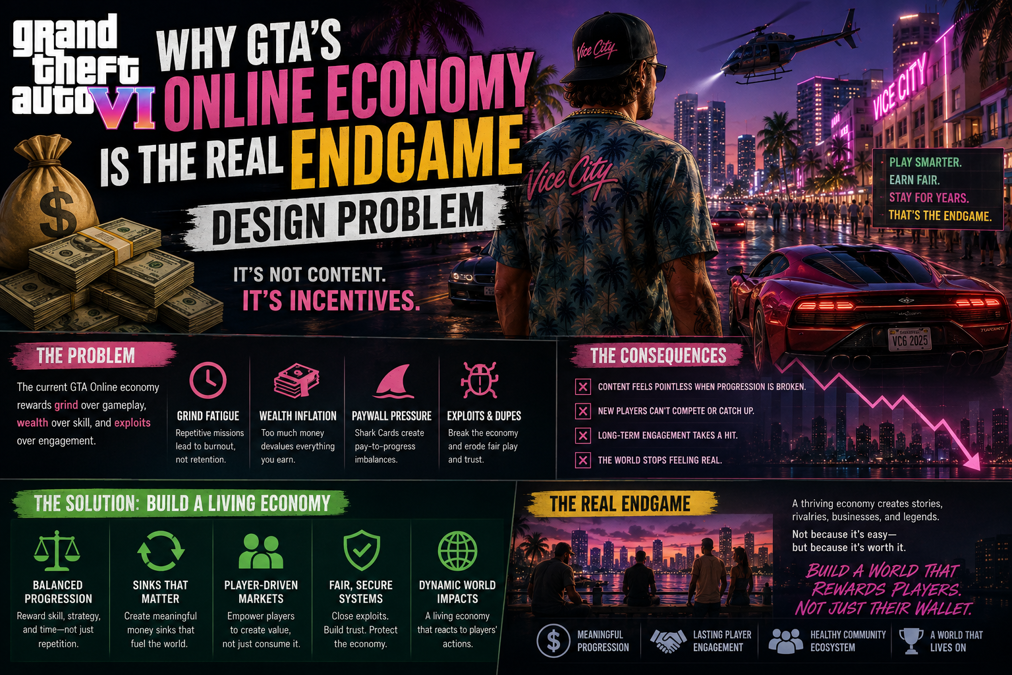
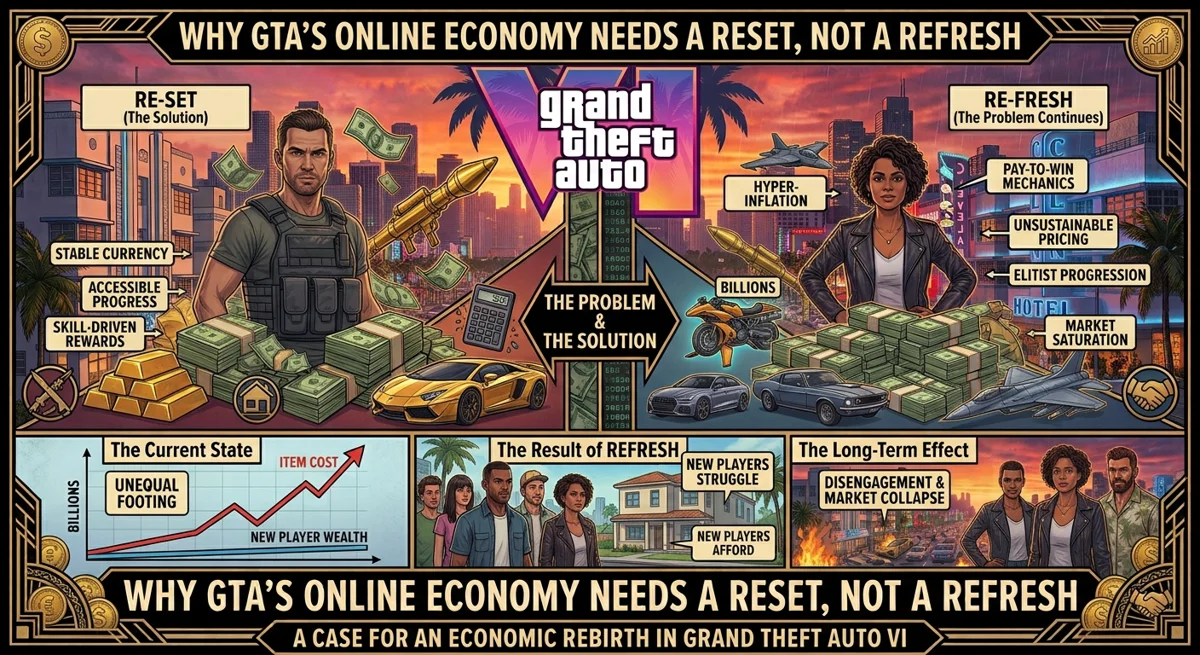
Let's call it what it is: GTA Online's economy has been in a slow-motion inflation spiral for the better part of a decade. The reason isn't mysterious. When your business model depends on players occasionally buying in-game currency, every new content drop has to be priced high enough to make that purchase feel rational. So prices climb. And to keep long-time players from feeling gouged, payouts on new content climb too. But payouts on old content — the missions and jobs new players actually start with — tend to stay frozen in amber.
The result is a two-tier world. Veterans farming the newest high-end business make more in an hour than a new player makes in a week of street-level crime. The onboarding experience becomes hostile in a very specific way: not because it's hard, but because it's economically pointless. Why steal a car for a few thousand when the cool stuff costs millions?
The Fantasy the Series Was Built On
The original appeal of GTA was always the arc. You start with nothing. You take small, stupid risks. You graduate to bigger, dumber risks. Eventually you're flying a helicopter into a bank vault, and somewhere along the way the city stopped feeling like a threat and started feeling like a playground you owned.
That arc is a gameplay arc, not a spreadsheet arc. It's about competence, notoriety, access. The economy is supposed to be the visible scoreboard for that story. When the numbers get so bloated that the only meaningful progression is "do I own the newest thing yet," the arc collapses into a shopping list. And shopping lists, no matter how beautifully rendered, are not what people fell in love with in San Andreas or Vice City.
What a Reset Could Actually Look Like
I'm not naive about this. A live-service game with a large audience can't just wave a wand and undo years of accumulated wealth without a riot. But a new online mode, launched alongside a new mainline title, is one of the very few chances in this industry to actually redraw the map. Here's what I'd want to see, in the abstract:
- Meaningful low-end economy. Petty crime should pay a livable in-game wage. Not glamorous, not fast, but real. A new player mugging tourists or running a stolen car to a chop shop should feel like they're making progress, not wasting time.
- Ceilings that hold. If the most expensive purchasable item in year one costs X, the most expensive item in year five shouldn't cost 50X. Content should expand sideways — new activities, new territory, new social spaces — more than it expands upward in price.
- Sinks that aren't just vanity. Cosmetics are fine. But an economy needs money sinks that feed back into gameplay: property upkeep, crew payroll, bribes, territory contests. Things that make being rich interesting instead of just being a scoreboard number.
- Time as the primary currency. The best possible signal that an economy is healthy is when a determined free player and a paying player end up in roughly the same place — the paying player just got there faster. That's the deal. Anything past that is exploitation dressed as convenience.
The Community Angle Everyone Underestimates
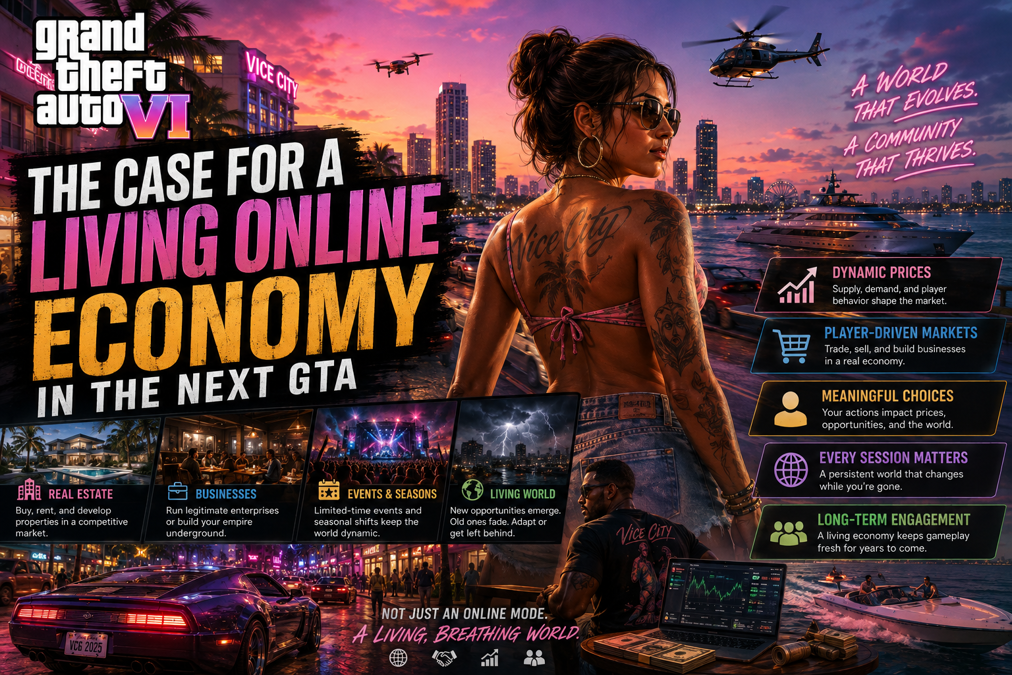
Here's the piece I think gets missed in most economy discussions: a good in-game economy is a social tool. When money is scarce and meaningful, players cooperate. They form crews out of necessity, not just aesthetics. They negotiate, they betray, they build reputations. When money is trivially abundant at the top and impossibly scarce at the bottom, the middle — where all the actual roleplay and emergent chaos happens — gets hollowed out.
Look at the roleplay servers that spun off from the last game. Their entire appeal was rebuilding the friction that the base game had priced out of existence. People voluntarily set up jobs, paychecks, and rent, because those systems generate stories. Rockstar, one imagines, has taken notes. The question is whether those notes make it past the executives who look at conversion rates on shark cards and see no problem worth solving.
Where Opinion Ends and Uncertainty Begins
I want to be careful here. I don't know what the next online mode will look like. Nobody outside a very small building in Edinburgh does, and anyone claiming otherwise is selling you something. What I'm arguing is directional, not predictive: if the next iteration inherits the same monetization philosophy, it will eventually inherit the same problems, no matter how good the launch content is.
The counter-argument is real too. The current model made an absurd amount of money. It funded, presumably, a great deal of what comes next. From a pure business standpoint, "do it again" is the safe call. But safety and longevity aren't the same thing. The players who churned out of the last online mode didn't leave because the missions were bad. They left because the math stopped being fun.
The Bar I'm Setting for Myself
When the next online mode arrives — whenever that is — I'm going to try to judge it on one specific question, before I get distracted by the graphics or the new mechanics or the map. The question is this: a week in, does a new player feel like a criminal on the rise, or like an unpaid intern?
Because that's the whole game, honestly. Everything else is set dressing.
Over to you: What's the one economy or progression change you most want to see in the next online mode — and what's the moment from the last one that made you finally put the controller down?