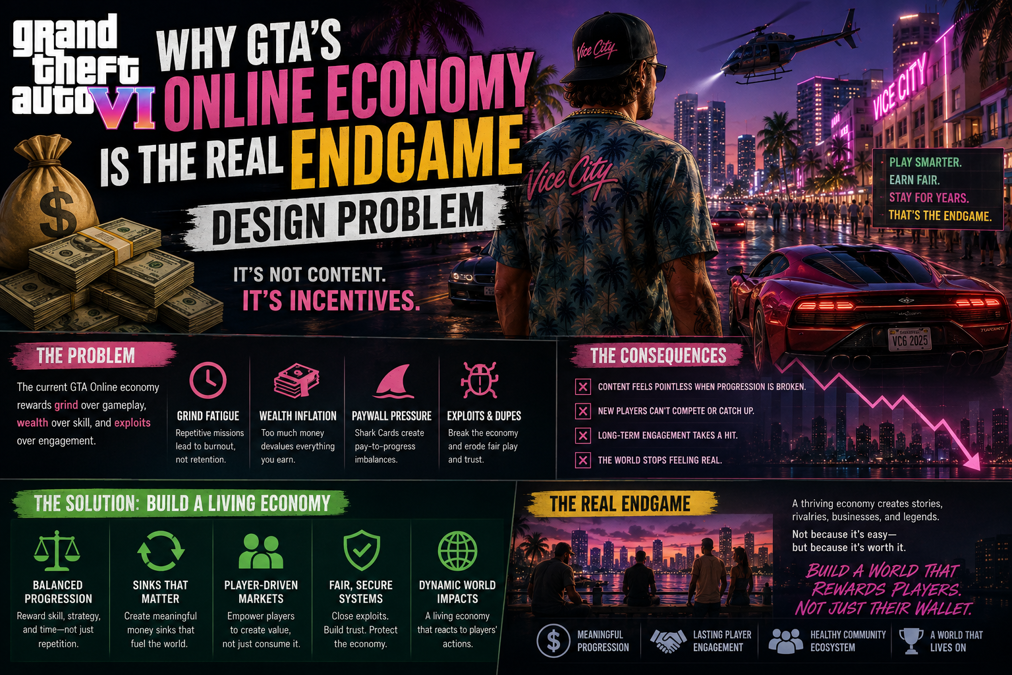
Every time a new Grand Theft Auto game looms on the horizon, the conversation drifts, almost gravitationally, toward the same handful of topics: how big the map will be, how many activities it will pack in, who the protagonists are, and what the trailer implied about the tone. Those are fun conversations. But if you want to know what will actually shape how millions of us spend thousands of hours inside Rockstar's next city, you have to look at something a lot less glamorous.
You have to look at the economy.
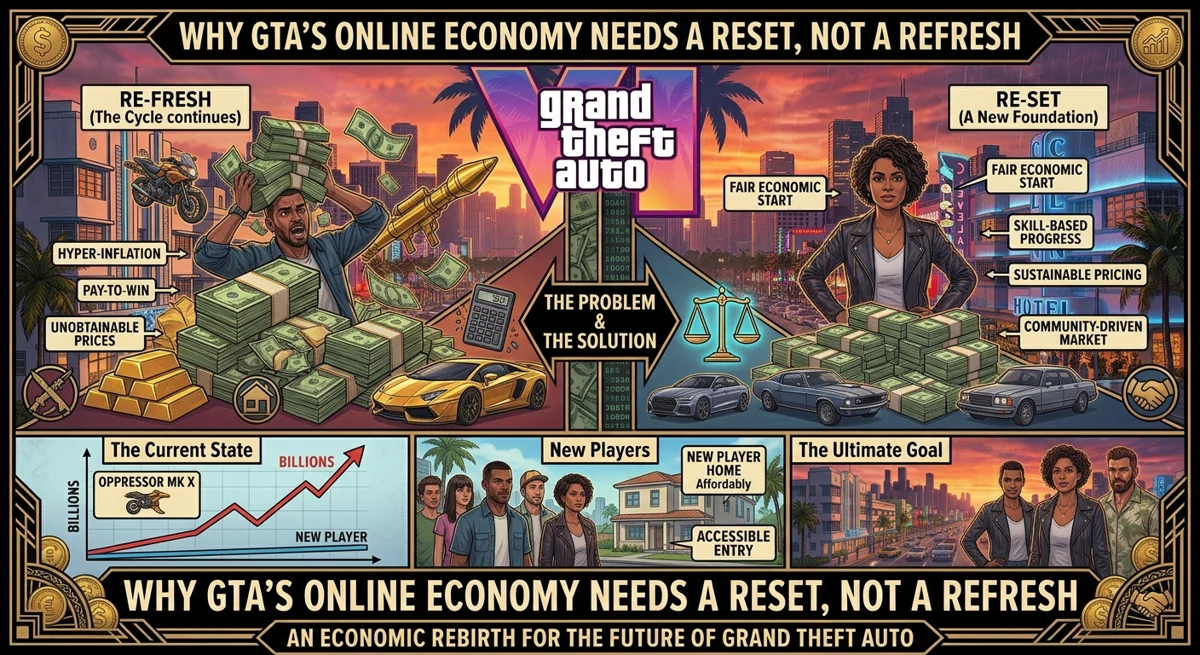
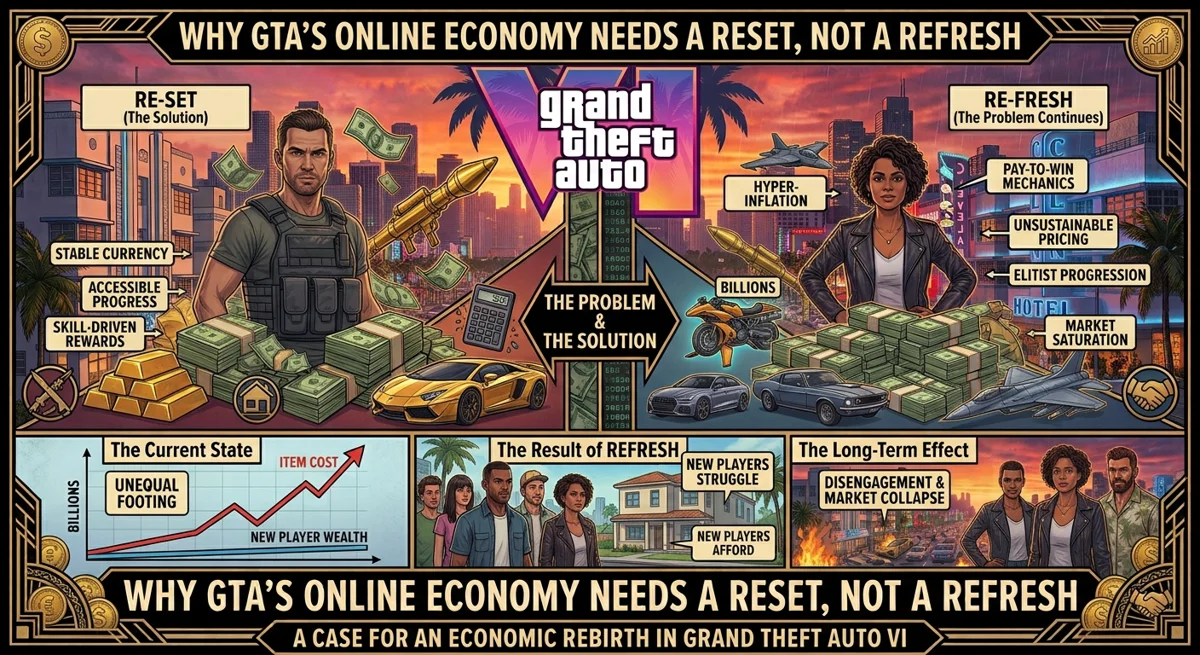
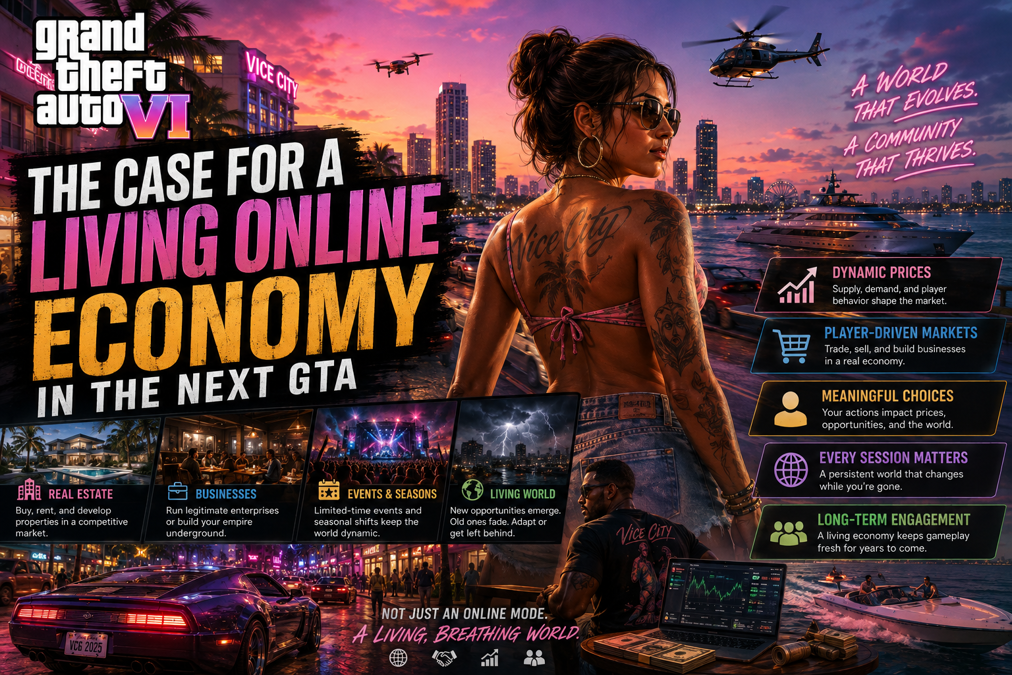
Not the fictional one — not the pawn shops and the stock market and the strip clubs on the corner. I mean the real, meta-economy that any modern GTA game is going to live or die by: the loop of money, time, and desire that keeps players logging in long after the credits roll. GTA Online turned that loop into one of the most successful entertainment products of the last decade. It also, quietly, turned into the thing that most divides its community. However Rockstar approaches it next time is, in my opinion, the single most important design decision they'll make.
What GTA Online Actually Taught Rockstar
Rewind to the launch of GTA Online. Back then it was a bolted-on multiplayer mode that most people expected to be a novelty — a way to run around Los Santos with friends for a couple of weekends before drifting back to single-player. What it became instead is well-documented: a live service that outlived console generations, absorbed dozens of major updates, and generated a genuinely astonishing amount of revenue from a base game most players had already paid for once.
The lesson Rockstar clearly took from that is: people will keep coming back if you keep giving them things to want. Cars. Businesses. Bunkers. Nightclubs. Submarines. Acid labs. Every update was, in the end, a new drip of aspiration attached to a new grind. And the grind is where the economy lives.
That's the part I want to sit with for a minute, because it's easy to mock and hard to actually design well. A too-generous economy trivializes ownership; nothing feels earned, and the fantasy of building an empire collapses into a checklist. A too-stingy economy pushes players toward two exits: shark cards, or burnout. GTA Online, particularly in its middle years, spent a lot of time uncomfortably close to that second cliff.
The Shark Card Problem Nobody Wants to Talk About
Let me be blunt: microtransactions in a premium-priced game are always going to be a tension point, and pretending otherwise is dishonest. When a new supercar drops and it costs the equivalent of ten hours of heist grinding — or a few dollars of real money — the game is making a very specific offer. It's saying: your time is worth this much, and if you don't have the time, we'll happily take the money.
I don't think that's inherently evil. Live-service games cost a fortune to run, and Rockstar isn't a charity. But the design consequence is real. When your economy is calibrated around a shortcut existing, the base grind has to be tuned steep enough to make the shortcut attractive. That means the default experience — the one most of your players actually have — is a little more painful than it needs to be. Multiply that across years of content and you get a game where new players open the map, see a hundred icons, and feel exhausted before they've even started.
Whatever the next GTA online experience looks like, this is the tightrope. I'm not naive enough to think the shark card model is going anywhere. But I do think the community has become much better at recognizing when a grind is designed to sell you a way out of itself, and that pressure matters.
Progression Should Feel Like a Story, Not a Spreadsheet
Here's the pitch I keep making to anyone who'll listen: the best moments in GTA Online were never the ones where you finally hit a number. They were the ones where the number unlocked a story. Buying your first apartment. Pulling off the Pacific Standard finale with a crew that mostly knew what they were doing. Setting up a nightclub and realizing you were basically running a logistics business now.
Those moments worked because the economy was doing narrative work. Money wasn't just a score; it was a lever that changed what kind of criminal you got to be. When the economy stops doing that — when it becomes a pure spreadsheet of hourly rates and optimal grinds — the game loses something that a bigger map and prettier lighting can't put back.
So the design question I'd love to see Rockstar wrestle with isn't how do we make money feel meaningful? It's how do we make spending it feel meaningful? A garage full of cars you never drive isn't a fantasy fulfilled; it's clutter with a price tag. The best economies in games — and I'd point to a lot of the classic single-player RPG loops here — make you feel your choices. You can't have everything, so what you pick says something about who you are in this world.
The Community Has Changed More Than the Game Has
One thing I don't think gets talked about enough is how much the players themselves have shifted since GTA V launched. The audience that will pick up the next GTA is fluent in live-service design in a way that the 2013 audience simply wasn't. They've played Fortnite seasons. They've watched MMOs rise and fall. They know what a battle pass is, they know when a daily login reward is manipulative, they know what predatory monetization smells like from ten feet away.
That sophistication cuts both ways. On one hand, players will be more patient with genuinely well-designed systems and more articulate about why they work. On the other, cynical monetization is going to get called out faster and louder than it ever was in the 2010s. The honeymoon window where a Rockstar logo bought infinite goodwill is, I think, narrower than it used to be. The game will still sell tens of millions of copies on day one — of course it will — but the second-year and third-year retention story is going to depend on decisions that haven't been made yet, or at least haven't been shown to us.
What I'm Actually Hoping For
I'll keep this section honest: this is opinion, not prediction. I'm not going to pretend I know what Rockstar is building. But if I got to whisper one thing in a designer's ear, it would be this: build the economy for the player who has two hours a week, not the player who has twenty.
Design the grind so that a casual session feels like meaningful progress. Design ownership so that having three cars you love is better than having thirty you don't. Design endgame content that respects the fact that at some point, players want to use what they've earned instead of grinding for the next tier. Do that, and the shark cards will still sell to the people who want them, and everyone else will actually enjoy being in the world.
The map will be gorgeous. The characters will be memorable. The set pieces will be all over social media for weeks. None of that is what I'm nervous about. What I'm nervous about is the invisible math underneath — the thing that decides whether we're all still logging in three years from now because we love it, or because we feel like we have to.
Over to you: if you could redesign one thing about how money and progression work in GTA's online world, what would it be — and what did the old game get right that you'd want protected at all costs?