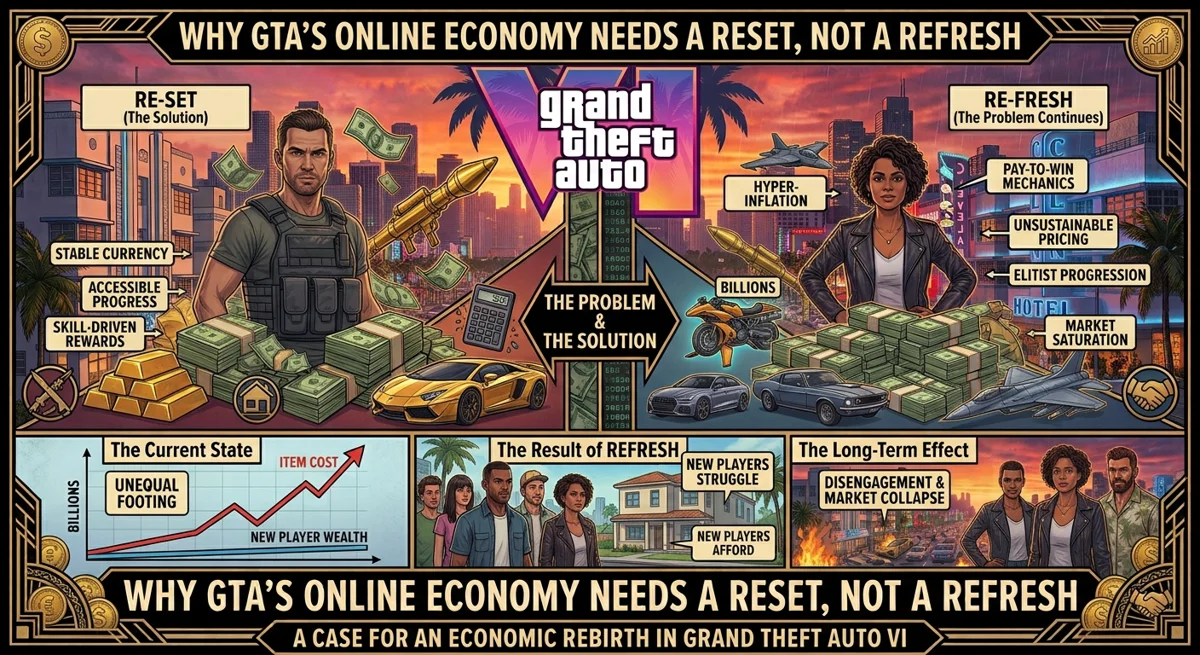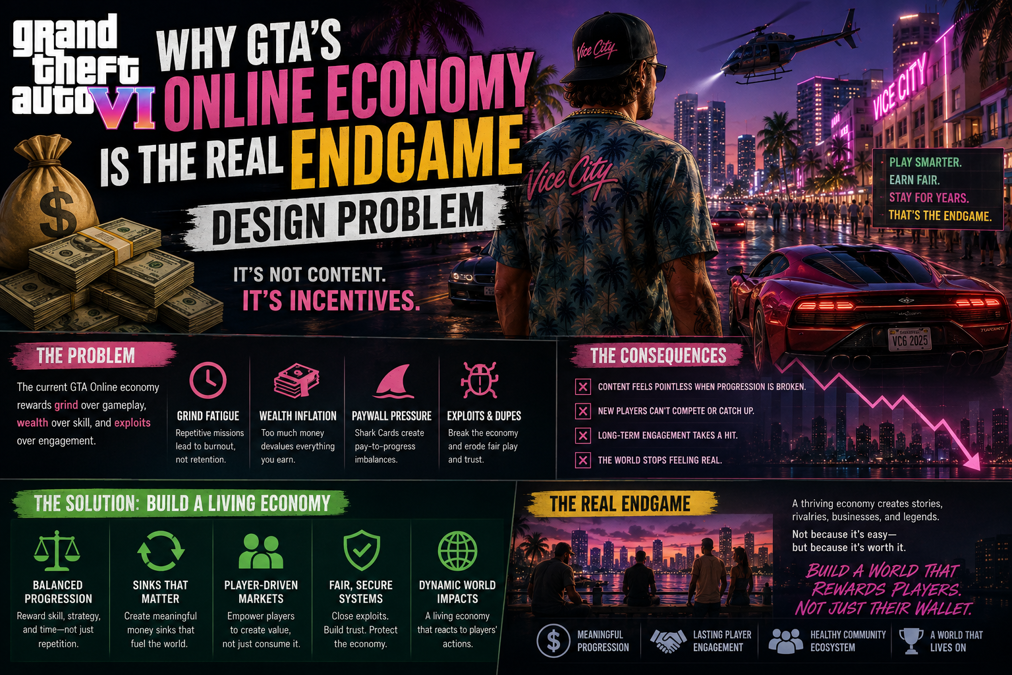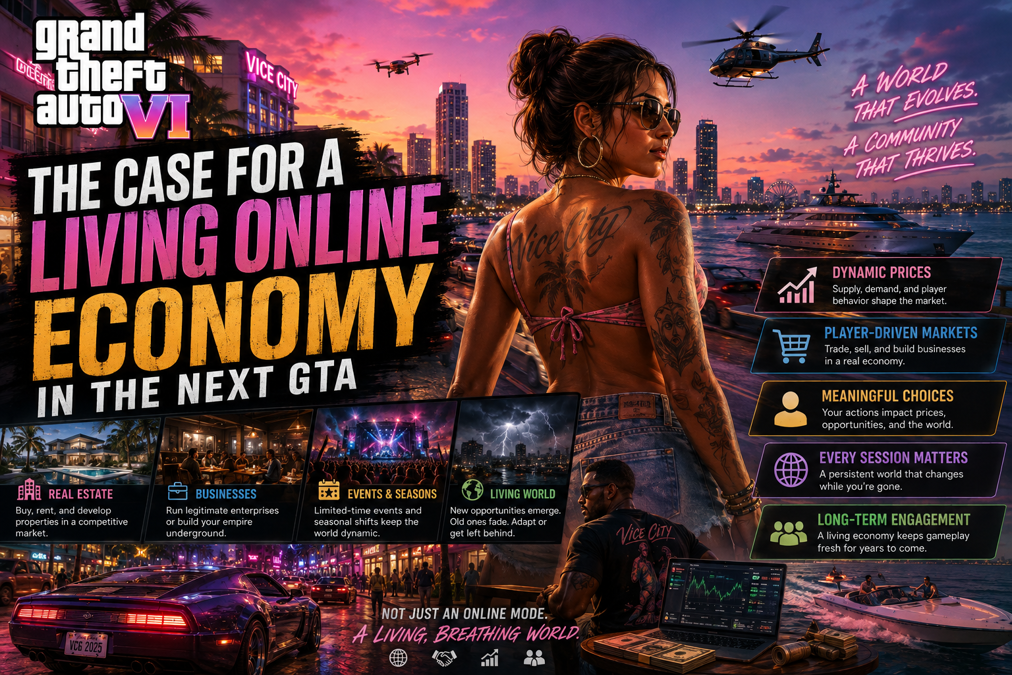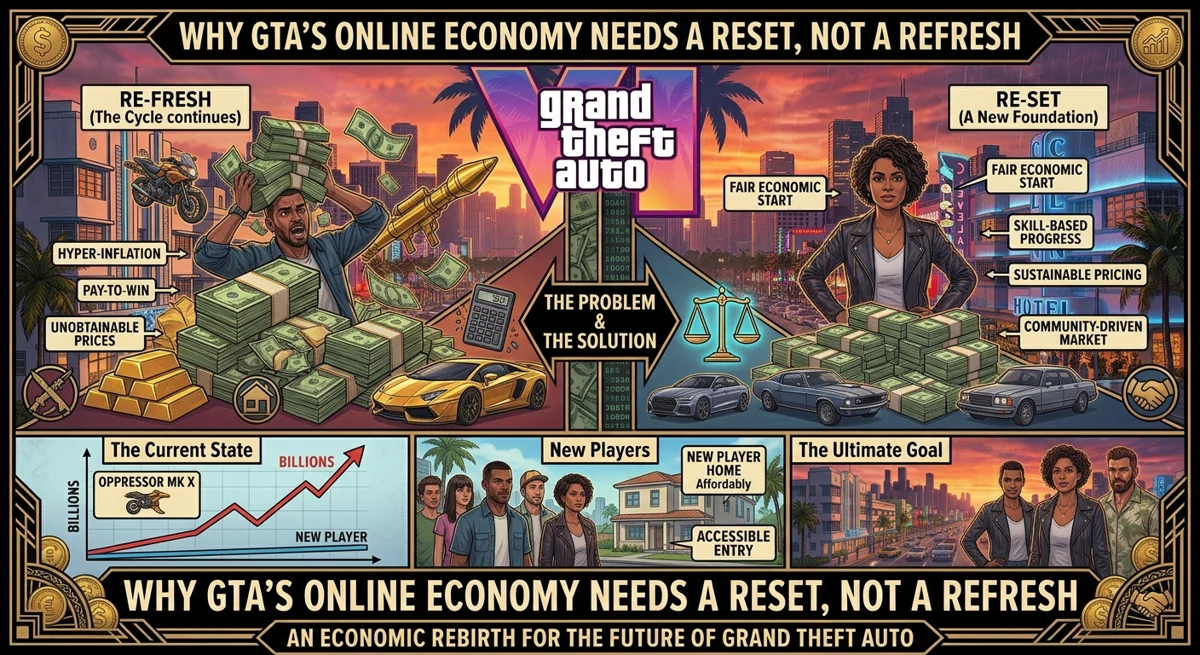
If there is one thing a decade of GTA Online taught us, it is that virtual economies are not neutral. They shape how we play, who we play with, and — eventually — whether we keep playing at all. As the community turns its eyes toward the future of the franchise, I want to make a case that has been bouncing around my head for a while now: the online economy in the next GTA does not need a refresh. It needs a full reset, from first principles.
This is an opinion piece, not a leak roundup. I have no insider info on what the next online mode will look like, and anyone claiming otherwise should be treated with the healthy skepticism this community has earned the hard way. What I do have is years of watching a brilliant sandbox slowly bend itself around the shape of its own store.
The Grind Became the Game
Somewhere along the way, GTA Online stopped being a chaotic playground and became a job. Not for everyone, and not all the time — but the gravitational pull was undeniable. New content dropped, and the first question in every friend group was not "what does it feel like?" but "what's the payout per hour?"
That is a subtle but important shift. When the primary lens on new content becomes efficiency, the sandbox loses. Heists stop being cinematic set pieces and become spreadsheets. Businesses stop being roleplay hooks and become supply timers you set an alarm for. Even the map, one of the most lovingly crafted spaces in gaming, gets flattened into "good grind spot" and "loading screen between grind spots."
None of this is the players' fault. We are rational actors responding to the incentives in front of us. If the game tells you that a single top-tier vehicle costs more than most players earn in a week of casual play, the game has already made the choice for you.
Shark Cards Cast a Long Shadow
Let's be honest about the elephant in the garage: premium currency shaped everything. I am not going to pretend that microtransactions are inherently evil — plenty of live-service games handle them gracefully. But GTA Online's version created a specific kind of tension where the price of in-game items appeared to drift upward over the years while the earning power of ordinary activities did not keep pace nearly as generously.
The result was a two-tier community. Players who paid up front for a wardrobe of supercars and a portfolio of businesses lived in a different game than players who logged in after school or work to slowly chip away at a single purchase. Neither group was wrong to play the way they did. But the ecosystem started to feel less like a shared city and more like two overlapping ones.
Any future online mode inherits that reputation whether it wants to or not. And that is why I think a soft "refresh" — better payouts here, a discount event there — will not be enough. Trust, once bent, does not snap back that easily.
What a Real Reset Could Look Like
So what would starting from first principles actually mean? I do not have a design document, but I do have a wishlist rooted in what has and has not worked historically across live-service games in general:
- Meaningful ceilings, not endless escalation. If the most expensive item in the game costs a reasonable amount of focused play to earn, the whole economy stabilizes around it. Endless power creep is what forces prices to keep climbing.
- Fun-first activities that happen to pay. The best sessions in GTA history were the ones you would have played for free — the chaotic free-roam nights, the improvised chases. Payouts should reward the things people already love doing, not bribe them into things they don't.
- Cosmetic-forward monetization. If real money is involved, keep it firmly on the cosmetic side of the line. Character expression, vanity vehicles, apartment decor — sure. Straight-up power and access, no.
- Anti-griefer economics. One overlooked point: economies collapse socially, not just numerically. When a two-hour grind can be erased by a single missile from a stranger, players stop investing. Any reset has to think about safety as an economic feature.
Notice that none of this requires bleeding-edge technology. It is a values question more than a technical one. What does the game want players to feel when they log in? Excitement, or obligation?
The Community Is Already Ahead of the Developers
Here is something I find genuinely hopeful. Spend any time in GTA community spaces and you will see players self-organizing around the exact values I just listed. Roleplay servers built entire alternative economies where cosmetics, story, and social status matter more than raw grind. Content creators quietly moved away from "best money method" videos and toward cinematic, character-driven storytelling. Casual crews invented their own house rules to make free-roam more habitable.
In other words, the community has been quietly voting with its time for years. The signal is there for anyone who wants to read it: people want a place to be, not a place to farm. A next-generation online mode that trusts that instinct — and designs its economy around it — has a chance to feel special in a way the old one hasn't in a long time.
What I'm Watching For
When we eventually get concrete details about the next online experience, I will not be looking first at the map size or the vehicle count or even the mission structure. I will be looking at three quieter numbers: how much a mid-tier apartment costs relative to an hour of casual play, whether premium currency exists and how aggressively it is surfaced, and whether the game's default free-roam rules protect a new player's first ten hours.
Those three signals will tell us almost everything about what kind of city we are being invited into. A world can have the most photorealistic sunsets in gaming history and still feel hollow if the economics underneath it are hostile. Conversely, a modest-looking sandbox with humane rules can hold a community for a decade.
The Stakes Are Higher Than One Game
One last thought. Whatever the next GTA online mode looks like, it is going to be studied, copied, and cited by every other open-world live-service game for years. That is the weight of this franchise. Getting the economy right is not just about our fun — it sets the tone for an entire genre's next chapter.
I want to be optimistic. There is a lot of accumulated wisdom, both inside the studio and out here in the community, about what works and what does not. The blueprint for a healthier online sandbox is not a secret. The question is whether the will exists to actually use it.
Over to you: if you could change one single thing about how the online economy worked last time — one rule, one price, one system — what would it be, and why? Drop your pick in the comments. I read them all.