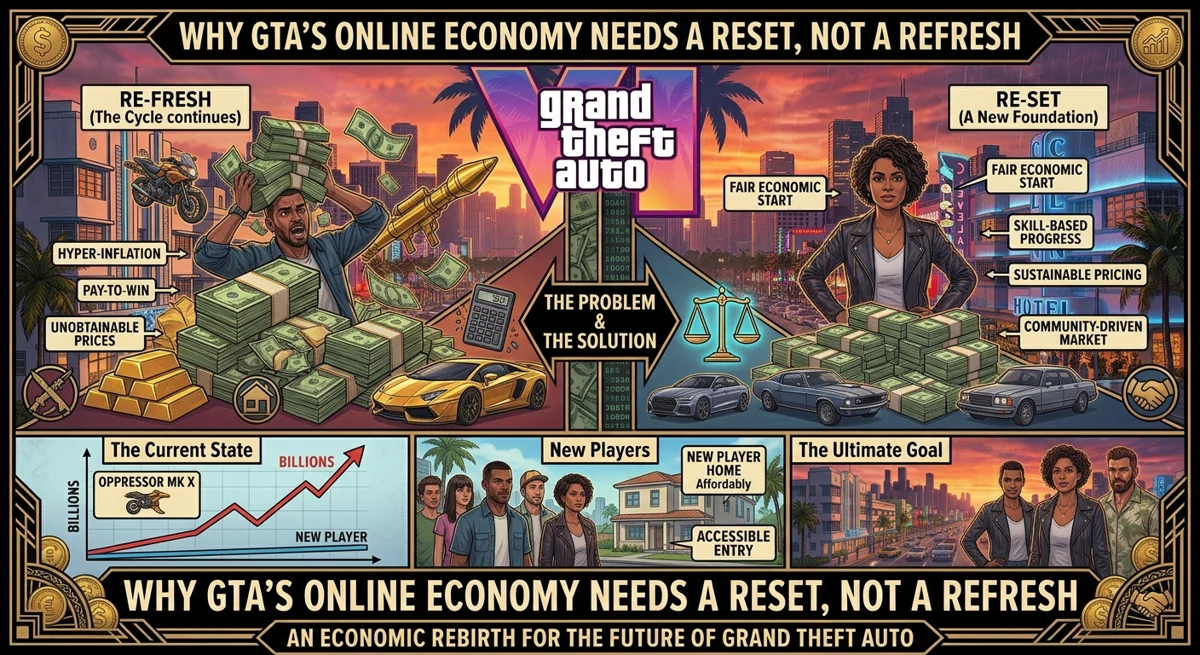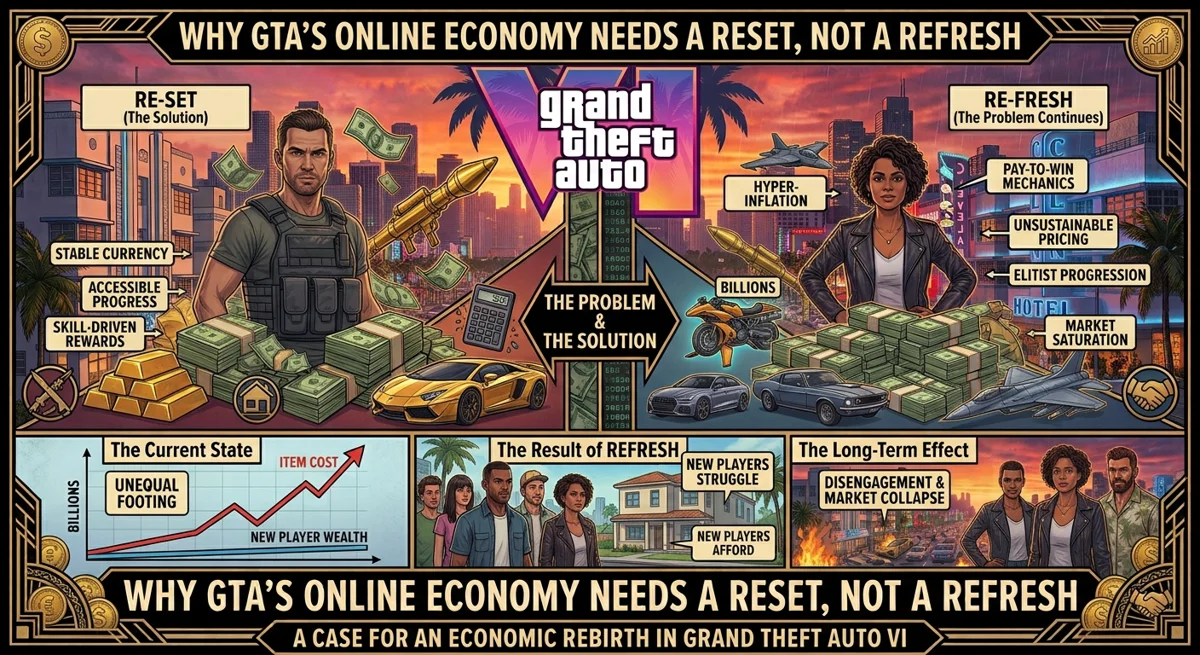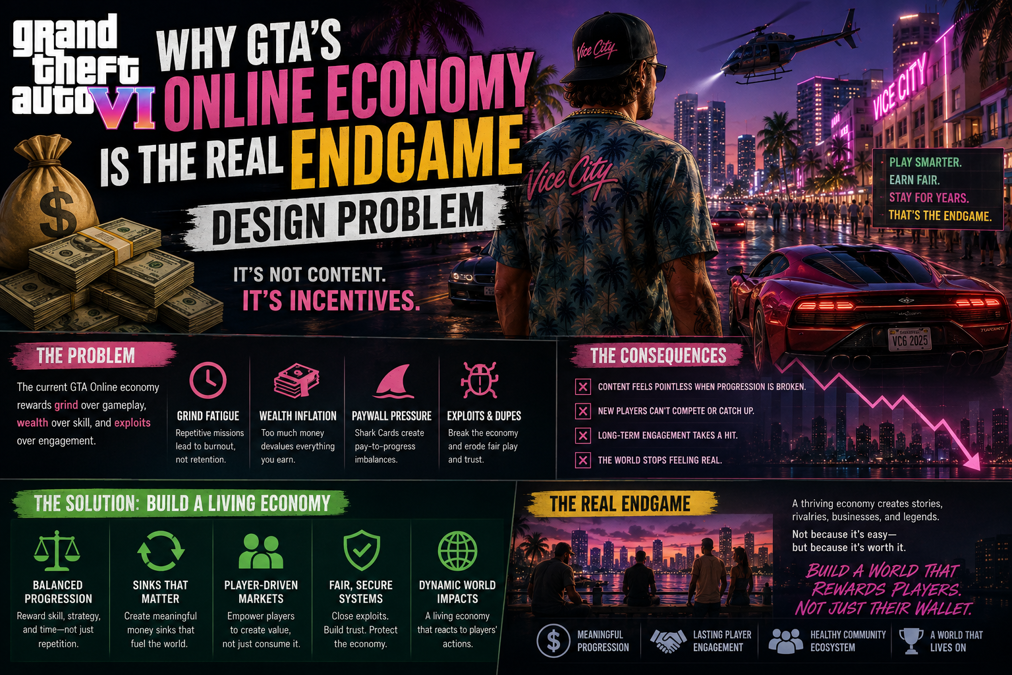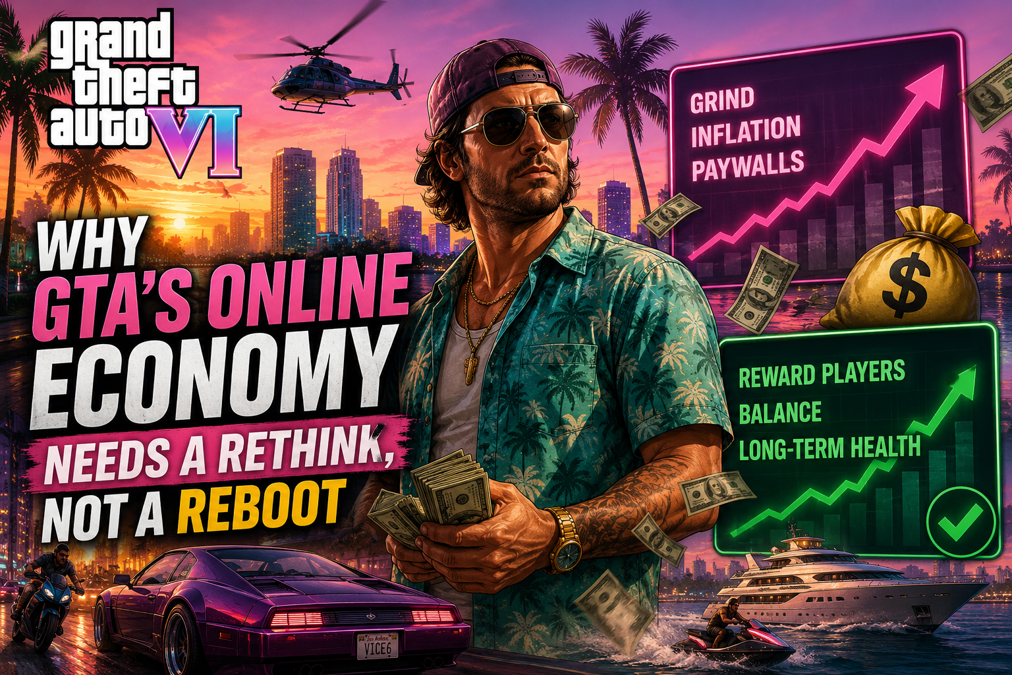
There's a specific kind of exhaustion that only GTA Online players understand. You log in, you're happy to be back, and then you remember: the new drip-feed vehicle costs more than your rent, the daily objectives want three hours of your evening, and the only reliable way to make money without grinding for a week is to buy Shark Cards. Somewhere between 2013 and now, Rockstar's online sandbox stopped feeling like a playground and started feeling like a spreadsheet with cars in it.
I want to be clear up front: this is opinion. I don't know what the next online mode will look like, and I'm not going to pretend I do. But GTA Online's economy is a decade-long case study sitting right there, and it would be genuinely strange if Rockstar didn't use it as a blueprint for what not to repeat. So let's talk about what actually broke, and what a healthier online economy could look like next time.
The Original Sin: Inflation as a Design Choice
When GTA Online launched, a high-end apartment cost a few hundred grand and a fully-kitted supercar was maybe a million. Fast forward through years of updates and we ended up in a world where a single new business property could run eight figures, and 'entry-level' endgame content assumed you'd already banked tens of millions.
That inflation wasn't an accident. Every time a new update dropped, prices climbed to justify longer grinds, which conveniently made microtransaction currency more attractive. It's a classic free-to-play economic curve — except GTA Online isn't free-to-play. You paid full retail for the base game, and the economy still behaved like a mobile gacha.
The result: veterans hoarded cash, new players drowned, and the gap between the two only widened. A friend who bounced off the game in 2019 tried to come back last year and quit within an hour because he genuinely couldn't afford to participate in anything modern. That's not a difficulty curve. That's a locked door.
Grind Is Not Content
Here's where I'll pick a fight: repeating the same heist setup for the fourteenth time is not gameplay. It's attendance. Somewhere along the way, 'content' in GTA Online became synonymous with 'a new thing you have to do sixty times to afford the next new thing.'
Good live-service games understand the difference. You can have long-tail progression without making every activity a slot machine of diminishing returns. When a player finishes a great mission, the reward should be the mission itself plus meaningful, visible progress — not a chore chart telling them to come back tomorrow and do it again for slightly more money because it's a 2X week.
The 2X payout events in particular are, in my opinion, a tell. They're an admission that the base payouts are too low. If the 'correct' way to play a mission is to wait until Rockstar temporarily doubles the reward, then the un-doubled reward was never balanced in the first place. It was a nudge toward the cash card store.
What a Healthier Economy Could Look Like
I don't think the answer is 'give players everything for free.' Money as a goal has always been core to GTA's identity — Michael, Franklin, and Trevor were, at the end of the day, chasing scores. Progression matters. Wanting something you can't afford yet is a good feeling, when it's calibrated right.
What I'd love to see instead:
- Flat, respectable payouts on core activities. If a heist takes an hour and requires four coordinated players, the payout should feel like a heist, not a tip jar.
- Cosmetics as the primary vanity sink. Let players who want to spend real money spend it on clothing, liveries, and interiors — things that don't gatekeep participation.
- Meaningful catch-up mechanics for returning players. Not handouts, but on-ramps. A returning player in month 36 shouldn't feel like they need a wiki open just to know what building to walk into.
- Fewer 'businesses,' more lives. The nightclub, bunker, MC, CEO, arcade, agency stack got absurd. A cleaner set of progression paths that intersect with the actual world would age much better.
- Kill the drip-feed. Or at least be honest about it. Locking already-finished vehicles behind arbitrary weekly gates is one of the most cynical patterns in modern live service.
The Community Half of the Equation
Economy design isn't only about numbers on a screen — it shapes how players treat each other. GTA Online's grind culture is a big reason public lobbies became famously hostile. When every minute of your session is worth money, someone blowing up your Post Op van isn't just annoying, it's an economic attack. That tension bred the whole 'invite-only session' meta, which in turn hollowed out the actual online part of the online game.
A game where money comes more naturally is a game where players are more relaxed about losing a little of it. It's a game where you might actually stay in a public lobby, because the cost of chaos isn't measured in wasted hours. I think a lot of the community's rougher edges are downstream of economic pressure, not the other way around.
The Legacy Problem Rockstar Has to Face
Here's the awkward part. GTA Online, whatever we think of its design, made a mind-boggling amount of money. From a pure business standpoint, the model worked. Any next-generation online mode has to answer an uncomfortable internal question: are we willing to make less money per player in exchange for a healthier, longer-lasting ecosystem?
I'd argue the answer should be yes, and that the long tail of a well-designed economy is actually more lucrative than a short, brutal one — but that's a bet, and it's a bet against a decade of proven revenue. It would take real discipline to walk away from the mechanics that printed money last time.
My hope, and it's only that, is that Rockstar has watched the live-service landscape evolve and noticed which games kept their players and which ones bled them dry. The most successful long-running online games in 2024 tend to be ones that respect a player's time. That respect is the single most valuable currency any studio can offer right now.
The Bar Is Higher Now
When GTA Online launched, 'persistent open-world multiplayer at this scale' was novel enough that a lot of design sins got forgiven. That grace period is over. Players have seen what fair progression looks like elsewhere. They've also seen what predatory design looks like, and they're louder about it than they used to be.
Whatever the next online sandbox from Rockstar ends up being, it's not going to get judged in a vacuum. It's going to get judged against every lesson the industry has learned — and every lesson GTA Online itself taught us, sometimes the hard way.
Over to you: what's the one economic or progression change you'd demand on day one of a new GTA online mode? Drop it in the comments — the pettier and more specific, the better.